Tag: #protoni

THE ATOMIC STRUCTURE

An atom is made up of subatomic particles called protons, neutrons and electrons.

  • Protons are positively charged particles;
  • Neutrons have no electrical charge;
  • Electrons are negatively charged particles.

As shown in Figure 1 below, an atom consists of an inner nucleus with protons and neutrons with electrons located outside the nucleus.
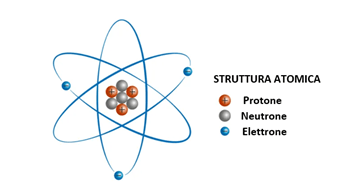
Figure 1 – Representation of the atomic structure.

All the positive charge is concentrated in the center of the atom, while the negative charge is distributed externally. The role of the neutron is to increase the distance between the protons and prevent proton-proton repulsive interactions from destabilizing the entire structure.

The masses of subatomic particles are extremely small.

  • Proton mass: 1.673×10⁻²⁷ kg
  • Neutron mass: 1,675×10−27 kg
  • Electron mass: 9,109×10−31 kg

The mass of the electron is nearly 2,000 times smaller than that of the proton and neutron, which is why it can be considered negligible.

Even the charges of subatomic particles are significantly small.

  • Proton charge: + 1.602×10⁻¹⁹ C
  • Neutron charge: 0 C
  • Electron charge: – 1.602×10⁻¹⁹ C

The charge of a proton is equal to the charge of an electron, though with the opposite sign. The overall charge of the atom is neutral, meaning the positive charge of the nucleus is balanced by the negative charge of the electrons.

Since the charge of a proton is equal to the charge of an electron, it’s easy to deduce:

IN AN ATOM THE NUMBER OF PROTONS IS EQUAL TO THE NUMBER OF ELECTRONS.

Atoms can be identified by two types of numbers:

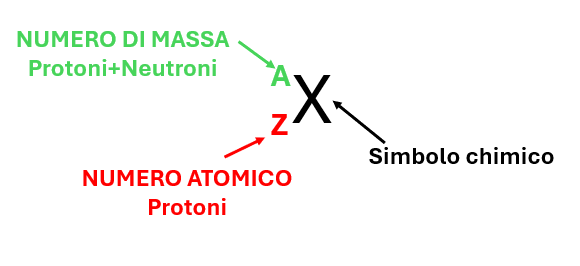
  • ATOMIC NUMBER (Z)  which represents the number of protons;
  • MASS NUMBER (A) which represents the sum of protons and neutrons.

The difference between the atomic number (Z) and the mass number (A) gives the number of neutrons.

As shown in Figure 2, a chemical element is described by two numbers: the atomic number (Z), which is listed in the lower left, and the mass number (A), which is listed in the upper left.
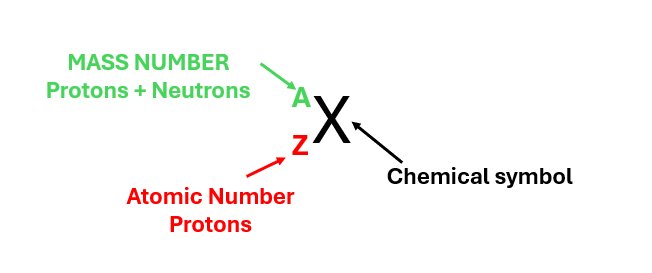
Figure 2 – Representation of a chemical element.

KEY POINTS:

  • MASS NUMBER (protons + neutrons) is always listed in the upper left;
  • ATOMIC NUMBER (protons) is always listed in the lower left;
  • In an atom the number of protons is equal to the number of electrons;
  • The number of neutrons is obtained by subtracting the atomic number from the mass number.

SOLVED EXERCISE:

Find the number of protons, neutrons, and electrons in the following atom:

  • Atomic number, reported in the lower left, represents the number of protons. p+= 6
  • The number of electrons is equal to the number of protons. e= 6
  • (Mass number – Atomic Number)= Number of neutrons. n = 12-6 = 6

SOLUTION:

p+= 6;

n = 6;

e= 6

NUMERO ATOMICO E NUMERO DI MASSA

Gli atomi vengono identificati attraverso due numeri:

  • IL NUMERO ATOMICO (Z)  che indica il numero di protoni;
  • IL NUMERO DI MASSA (A) che indica la somma di protoni e neutroni.

La differenza tra NUMERO DI MASSA e NUMERO ATOMICO (A-Z) dà come risultato il numero di neutroni.

In Figura 1, in una rappresentazione schematica di un elemento chimico, il NUMERO ATOMICO (Z) è riportato in basso a sinistra, mentre il NUMERO DI MASSA (A) è riportato in alto a sinistra.

Figura 1 – Rappresentazione schematica del NUMERO ATOMICO (Z) e NUMERO DI MASSA (A)

Il numero atomico identifica in maniera unica un elemento chimico. Come mostrato in Figura 2, la tavola periodica è rappresentata da tante caselle consecutive, ciascuna contenente un elemento chimico raffigurato con una singola lettera (H, B, C, N, O, F, ecc.) o due lettere (Ca, Mg, Na, Li, Be, Hg, ecc.). La prima lettera è sempre riportata con la lettera maiuscola.

Figura 2 – Rappresentazione del numero atomico (Z) nella tavola periodica

Il numero atomico è sempre associato a UNO E UNO SOLO elemento chimico della tavola periodica. Costituisce l’impronta digitale dell’elemento.

All’Idrogeno è associato sempre e solo il Numero Atomico 1, all’Elio 2, al Litio 3, al Berillio 4, al Boro 5 e così via.

  • Il NUMERO DI MASSA (protoni + neutroni) è sempre riportato in alto a sinistra;
  • Il NUMERO ATOMICO (protoni) è sempre riportato in basso a sinistra;
  • Per ottenere il numero di neutroni è sufficiente calcolare la differenza tra NUMERO DI MASSA e NUMERO ATOMICO.
  • A un elemento chimico è sempre associato un solo NUMERO ATOMICO.

Determinare il numero di protoni, neutroni ed elettroni del seguente atomo:

  • Il numero atomico rappresenta il numero di protoni ed è riportato in basso a sinistra. p+= 6
  • Il numero di elettroni è uguale al numero di protoni. e= 6
  • (Numero di massa – Numero atomico)= Numero di neutroni. n = 12-6 = 6

LA STRUTTURA ATOMICA

L’atomo è costituito da particelle subatomiche chiamate PROTONI, NEUTRONI ed ELETTRONI.

  • I protoni sono particelle subatomiche cariche positivamente;
  • I neutroni sono particelle subatomiche senza carica elettrica;
  • Gli elettroni sono particelle subatomiche cariche negativamente.

Come mostrato nella Figura 1 sottostante, un atomo è composto da un nucleo interno con protoni e neutroni, chiamati per questo anche nucleoni, con gli elettroni collocati esternamente.

Figura 1 – Rappresentazione della struttura atomica

Tutta la carica positiva è concentrata al centro dell’atomo mentre le cariche negative sono distribuite esternamente. Il ruolo dei neutroni (neutri elettricamente) è quello di aumentare la distanza tra i protoni ed evitare che le forze di repulsione protone-protone destabilizzino la struttura dell’atomo.

La massa delle particelle subatomiche risulta essere estremamente piccola:

  • Massa del protone: 1,673×10−27 kg
  • Massa del neutrone: 1,675×10−27 kg
  • Massa dell’elettrone: 9,109×10−31 kg

I valori elencati indicano la trascuratezza della massa dell’elettrone confrontata a quella del protone e del neutrone. Da un calcolo più dettagliato risulta che la massa dell’elettrone è circa 2000 inferiore rispetto a quella delle altre due particelle subatomiche.

Anche la carica di una particella subatomica assume valori di ridotta entità:

  • Carica del protone: + 1,602×10−19 C
  • Carica del neutrone: 0 C
  • Carica dell’elettrone: – 1,602×10−19 C

La carica di un singolo protone è uguale a quella di un elettrone sebbene con valore opposto. Nella suo insieme, l’atomo è elettricamente NEUTRO. La carica positiva dei protoni nel nucleo viene neutralizzata dalla carica negativa degli elettroni fuori dal nucleo.

Se teniamo in considerazione che la carica di un protone uguaglia quella di un elettrone, si può facilmente dedurre che:

IN UN ATOMO IL NUMERO DI PROTONI UGUAGLIA ESATTAMENTE IL NUMERO DI ELETTRONI

Gli atomi vengono identificati attraverso due numeri:

  • IL NUMERO ATOMICO (Z)  che indica il numero di protoni presenti;
  • IL NUMERO DI MASSA (A) che indica la somma di protoni e neutroni.

La differenza tra NUMERO DI MASSA e NUMERO ATOMICO (A-Z) dà come risultato il numero di neutroni.

In Figura 2, in una rappresentazione schematica di un elemento chimico, il NUMERO ATOMICO (Z) è riportato in basso a sinistra mentre il NUMERO DI MASSA (A) è riportato in alto a sinistra.

Figura 2 – Rappresentazione schematica del NUMERO ATOMICO (Z) e NUMERO DI MASSA (A)

Concetti chiave:

  • Il NUMERO DI MASSA (protoni + neutroni) è sempre riportato in alto a sinistra;
  • Il NUMERO ATOMICO (protoni) è sempre riportato in basso a sinistra;
  • In un atomo il numero di elettroni uguaglia il numero di protoni;
  • Per ottenere il numero di neutroni è sufficiente calcolare la differenza tra NUMERO DI MASSA e NUMERO ATOMICO.

ESERCIZIO SVOLTO:

Determinare il numero di protoni, neutroni ed elettroni del seguente atomo:

  • Il numero atomico rappresenta il numero di protoni ed è riportato in basso a sinistra. p+= 6
  • Il numero di elettroni è uguale al numero di protoni. e= 6
  • (Numero di massa – Numero atomico)= Numero di neutroni. n = 12-6 = 6

RISULTATO:

p+= 6;

n = 6;

e= 6